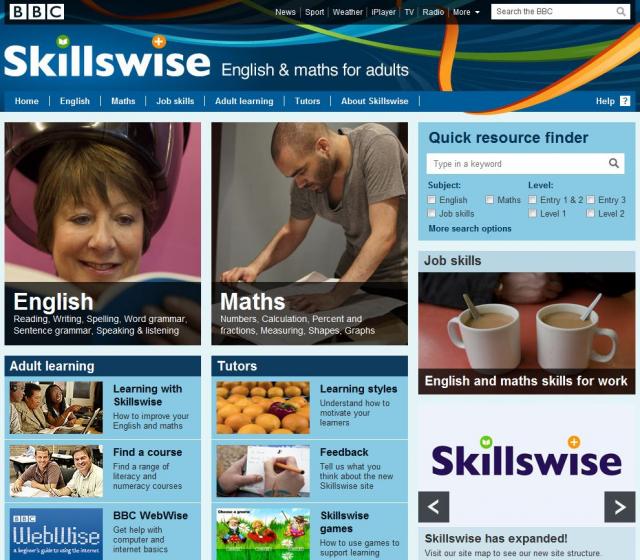
Here is a link to the punctuation practise we did this morning: http://www.bbc.co.uk/skillswise/topic/punctuation
There are many more activities on the BBC Skillswise website. Explore the website and let me know what you think. Which activities do you find the most useful and enjoyable? Is there anything you want to practise more in class? Leave a comment and let me know.
Wednesday, 26 February 2014
Tuesday, 28 January 2014
Vocabulary Games: Describing people
There are lots of games on different websites to help you learn vocabulary. Here are some online games you can try to help you learn some adjectives you can use to describe people. The website is called www.manythings.org
Grammar: -ed/-ing adjectives
Do you feel confused when you see different adjectives? Do you think adjectives are confusing? You are not alone.
There are many different suffixes (final letters) for adjectives. Among the most common are: -ive (positive), -ible (possible), -able (comfortable), -ish (babyish), and -ed/-ing (confused/confusing). Let's look at -ed/-ing adjectives.
Monday, 13 January 2014
State verbs
Q: Which famous company uses incorrect grammar in their advertisements?
In English, we can use verbs to talk about actions or feelings and emotions. Verbs that describe actions, for example, run, write, sing, are called action or dynamic verbs. We can use them in both simple and continuous tenses: Sorry, I can't stop! I am running a race!/ I run two miles every day.
Friday, 13 December 2013
Important Vocabulary
It's important to remember that you cannot learn lots of new words. You need to learn the most common words and be able to spell them correctly.
Here is a quiz of the 100 most common words in English: http://quizicon.com/100-Most-Common-English-Words-Quiz.html How many can you guess?
There are different lists of the most common words, but they are all very similar. They say that half of all written English uses the same 100 words. The top 300 words are used in 65% of all written English. Here are some word lists:
http://www.englishclub.com/vocabulary/common-words-100.htm
http://www.duboislc.net/EducationWatch/First100Words.html
http://www.world-english.org/english500.htm
Try and learn these common words and spell them correctly. They are the most important words to learn.
Here is a quiz of the 100 most common words in English: http://quizicon.com/100-Most-Common-English-Words-Quiz.html How many can you guess?
There are different lists of the most common words, but they are all very similar. They say that half of all written English uses the same 100 words. The top 300 words are used in 65% of all written English. Here are some word lists:
http://www.englishclub.com/vocabulary/common-words-100.htm
http://www.duboislc.net/EducationWatch/First100Words.html
http://www.world-english.org/english500.htm
Try and learn these common words and spell them correctly. They are the most important words to learn.
Friday, 29 November 2013
Vocabulary and Dictionaries
It's a very good idea to buy a dictionary to help you build your vocabulary. Many students use translators, but the context of the word (for example, the other words in the sentence) can change the meaning. It is much better to use an English dictionary: it will give you a sentence so you can see how the word is used; it will tell you what kind of word it is (noun, adjective etc); and will also give you the pronunciation of the word.
Here is a link to the FREE Cambridge Online Dictionary: http://dictionary.cambridge.org/dictionary/essential-british-english/
Try and use the dictionary when you see a new word and add the link to your mobile phone. The more you practise with the dictionary, the more useful it will be.
You can read some more about dictionaries here: http://www.kapmanchester.blogspot.co.uk/2013/07/its-really-important-that-you-use-good.html
Here is a link to the FREE Cambridge Online Dictionary: http://dictionary.cambridge.org/dictionary/essential-british-english/
Try and use the dictionary when you see a new word and add the link to your mobile phone. The more you practise with the dictionary, the more useful it will be.
You can read some more about dictionaries here: http://www.kapmanchester.blogspot.co.uk/2013/07/its-really-important-that-you-use-good.html
Sunday, 3 November 2013
Listening: Sean Banville and Halloween
Sean Banville is a blogger who has created many websites and lessons. His blog is here: http://seanbanville.com/
And here is the link to his Halloween lesson: http://www.eslholidaylessons.com/10/halloween.html
Near the top of the page, you will see a box called DOWNLOADS. In the box, you can click on MP3 Listening to listen to the recording, and you can also complete many activities online or save them as a PDF or Word document.
And here is the link to his Halloween lesson: http://www.eslholidaylessons.com/10/halloween.html
Near the top of the page, you will see a box called DOWNLOADS. In the box, you can click on MP3 Listening to listen to the recording, and you can also complete many activities online or save them as a PDF or Word document.
Saturday, 26 October 2013
Grammar: Test
Here is a useful link to a grammar test. Every time you take the test, the computer generates a different one.
Oxford Living Grammar is published by Oxford University. You can buy the book to practise. I like the book because there is always a context, a story where you can see how the grammar works in every day situations. However, I think that the grammar explanations are not always very clear.
Anyway, here is the link: https://elt.oup.com/student/livinggrammar/pre/a_test?cc=gb&selLanguage=en You can also test at other levels (elementary, intermediate). There is no explanation here of the grammar: you will need to write down or print your wrong answers and then try and find out more in the Study Centre. Good luck!
Oxford Living Grammar is published by Oxford University. You can buy the book to practise. I like the book because there is always a context, a story where you can see how the grammar works in every day situations. However, I think that the grammar explanations are not always very clear.
Anyway, here is the link: https://elt.oup.com/student/livinggrammar/pre/a_test?cc=gb&selLanguage=en You can also test at other levels (elementary, intermediate). There is no explanation here of the grammar: you will need to write down or print your wrong answers and then try and find out more in the Study Centre. Good luck!
Song: Yesterday
Here is a very famous song by The Beatles. Notice how the song begins with "Yesterday": the time comes at the beginning of the sentence.
http://www.lyricstraining.com/game1680.htm
Thursday, 17 October 2013
Grammar: Present simple
Welcome to Manchester! What do you know about the city?
Manchester is nearly 2000 years old, so has a very long and complex history. It is probably best-known for its music and its two world-famous football teams. Manchester United play at Old Trafford and most students want to visit the stadium when they are here. Manchester City's home is the Etihad Stadium which is in east Manchester. Old Trafford is the larger stadium, and holds 10,000 more spectators.
There are many music venues in the city. The area behind Piccadilly Gardens is The Northern Quarter and there are lots of places where you can listen to local bands.
A very popular area in Manchester is Rusholme, where there are many Arabic and Indian restaurants. People go there with their friends and eat different kinds of food. Many buses go to Rusholme. During Eid celebrations, the area gets extremely busy: buses use different routes and lots of people walk along the streets and make a lot of noise.
Most students think that the people in Manchester are friendly, so you don't need to worry about asking people questions. A lot of people think that it rains all the time in Manchester, but it really doesn't rain every day. I hope that you have a great time while you are here!
Look at the verbs in the text. What tense are the verbs?
Manchester is nearly 2000 years old, so has a very long and complex history. It is probably best-known for its music and its two world-famous football teams. Manchester United play at Old Trafford and most students want to visit the stadium when they are here. Manchester City's home is the Etihad Stadium which is in east Manchester. Old Trafford is the larger stadium, and holds 10,000 more spectators.
There are many music venues in the city. The area behind Piccadilly Gardens is The Northern Quarter and there are lots of places where you can listen to local bands.
A very popular area in Manchester is Rusholme, where there are many Arabic and Indian restaurants. People go there with their friends and eat different kinds of food. Many buses go to Rusholme. During Eid celebrations, the area gets extremely busy: buses use different routes and lots of people walk along the streets and make a lot of noise.
Most students think that the people in Manchester are friendly, so you don't need to worry about asking people questions. A lot of people think that it rains all the time in Manchester, but it really doesn't rain every day. I hope that you have a great time while you are here!
Look at the verbs in the text. What tense are the verbs?
Monday, 7 October 2013
Writing: The Great Detective
Many students find writing extremely difficult. One problem that many students have is cohesion: all the ideas need to be connected. I can often read a paragraph by a student and I think "oh, this is a nice paragraph about food", then suddenly WHAM!! The student writes a sentence about their weekend! Food and the weekend are not connected. There is no cohesion here.
Here is a short story about a great detective. However, the sentences are in the wrong order. Can you put the sentences in the correct order? (To make things a little easier, the first sentence is number 1.)
1. The great detective was smoking his pipe at the end of a long day.
2. There was no answer.
| a magnifying glass |
1. The great detective was smoking his pipe at the end of a long day.
3. Nothing happened.
4. Suddenly, there was a quiet knock on the door.
5. "Come in", called the great detective.
6. He put down his pipe and walked over to the door.
7. "Come in", he shouted again.
8. The telephone rang.
9. The man was still breathing.
10.When he opened it, the body of a man fell into the room.
11. He fell to the ground and listened carefully.
There is one sentence here that is not necessary. Which is it?
Copy the sentences and try and write the story in the correct order. The answers are after the jump.
4. Suddenly, there was a quiet knock on the door.
5. "Come in", called the great detective.
6. He put down his pipe and walked over to the door.
7. "Come in", he shouted again.
8. The telephone rang.
9. The man was still breathing.
10.When he opened it, the body of a man fell into the room.
11. He fell to the ground and listened carefully.
There is one sentence here that is not necessary. Which is it?
Copy the sentences and try and write the story in the correct order. The answers are after the jump.
Saturday, 28 September 2013
Grammar: Countable or Uncountable Quiz
This is a link to a quiz about countable and uncountable nouns: http://a4esl.org/q/j/ck/ch-countnouns.html There are 107 questions!! All you need to do is click on Countable or Non-countable.
Labels:
Blue,
Countable Nouns,
Few,
Grammar,
Little,
Lower Intermediate,
Many,
Much,
Uncountable Nouns
Friday, 27 September 2013
Essay Homework
Here are the slides from the lesson. They will help you to complete the writing homework.
First of all, look at this slide. You will write about past experiences, so you need to use both the present perfect and the past simple. What is the difference between the two? There are answers on the blog, but can you complete these sentences using the verbs (sometimes you will need a negative sentence):
Click "read more" to look at the answers:
First of all, look at this slide. You will write about past experiences, so you need to use both the present perfect and the past simple. What is the difference between the two? There are answers on the blog, but can you complete these sentences using the verbs (sometimes you will need a negative sentence):
Click "read more" to look at the answers:
Thursday, 19 September 2013
Vocabulary Game: Free Rice
The Free Rice website tests your vocabulary through multiple choice questions. There are sixty levels. When you have answered the first few questions, the website will try and judge your level. Level 60 is really hard! I found it almost impossible!!
Here's the good part: if you get the question right, the company will donate 10 grains of rice to charities which help feed the poor. So the more questions you answer correctly, the more rice they donate!
Here's the link: http://freerice.com/#/english-vocabulary/1509
Here's the good part: if you get the question right, the company will donate 10 grains of rice to charities which help feed the poor. So the more questions you answer correctly, the more rice they donate!
Here's the link: http://freerice.com/#/english-vocabulary/1509
Saturday, 14 September 2013
Grammar: Making Tenses
We all need a hand occasionally to help us get what we want. Even a genius like Michelangelo needed help to create his famous sculpture, David, which was made from marble for the city of Florence.
The statue doesn't look simple because it is extremely detailed.
Michelangelo was working continuously on the sculpture for two years while the city was waiting for him to finish it.
Millions of people have seen the perfect statue.
Verbs are like blocks of marble: they need help to make them come to life.
Ryan: "You, my students, are all Michelangelo." Students: "Wow!"
The statue doesn't look simple because it is extremely detailed.
Michelangelo was working continuously on the sculpture for two years while the city was waiting for him to finish it.
Millions of people have seen the perfect statue.
Verbs are like blocks of marble: they need help to make them come to life.
Ryan: "You, my students, are all Michelangelo." Students: "Wow!"
Labels:
Food,
Grammar,
Idioms,
Past Tenses,
Present Continuous,
Present Perfect,
Present Simple,
Tenses,
Verbs
Monday, 9 September 2013
Song: If You Don't Know Me By Now
Here is a link to this famous song by Simply Red at lyricstraining.com: http://www.lyricstraining.com/play/3357/simply_red/if_you_dont_know_me_by_now
The song is quite slow so you may be able to try the Intermediate level.
Friday, 6 September 2013
Song: You Don't Have To Say You Love Me
Here is a link to a song that talks about choices. This was a big hit in 1966 for the British singer Dusty Springfield. The song is about a woman begging the man she loves to come back to her.
Here is the link on lyricstraining.com: http://www.lyricstraining.com/play/22458/you_dont_have_to_say_you_love_me/dusty_springfield
Choose Beginner and listen to the song. Type in the missing words. You can only type in the letters that are in the word. If you need to listen to a line of the song again, press the backspace <----- key . Enjoy!!
Here is the link on lyricstraining.com: http://www.lyricstraining.com/play/22458/you_dont_have_to_say_you_love_me/dusty_springfield
Choose Beginner and listen to the song. Type in the missing words. You can only type in the letters that are in the word. If you need to listen to a line of the song again, press the backspace <----- key . Enjoy!!
Grammar: Modals of Obligation (Must/ Have to)
We often want to talk about choice. Sometimes we can make a choice but many times we cannot. There are rules and laws that mean we cannot choose to do what we always want to do.
The shop is closing down: the shop will not exist anymore. The shop is selling all its clothes in order to make as much money as possible. It has no choice. All the clothes must be sold. Everything must go!
We use must and have to to talk about choices.
The shop is closing down: the shop will not exist anymore. The shop is selling all its clothes in order to make as much money as possible. It has no choice. All the clothes must be sold. Everything must go!
We use must and have to to talk about choices.
Labels:
Grammar,
Green,
Have to,
Lower Intermediate,
Modal verbs,
Must,
Obligation
Wednesday, 4 September 2013
How To Brew Tea: Listening
The Videojug website has lots of videos that give instructions and tell you how to do things. Here is a link to the food section: http://www.videojug.com/tag/food-recipes
This is the video we watched in class: http://www.videojug.com/film/how-to-brew-tea
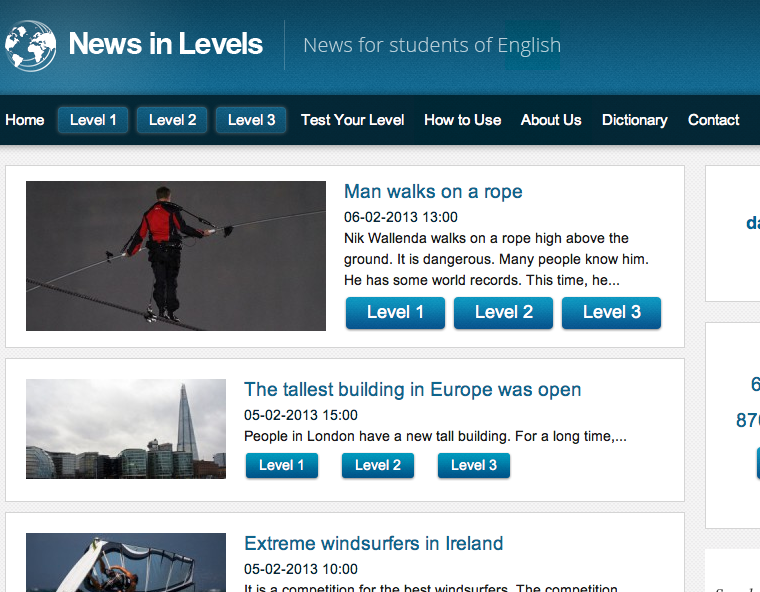
A News Website: Reading, Listening, Vocabulary
Here is a news website which might help you:
You can read and listen to the same news article at three different levels. Read level 1 first and listen to the recording. If this is too easy, read level 2 and listen to the recording.
Then you need to read more texts at the same level. The texts use the same group of words, so the more you read at the same level, the more words you will be able to remember.
Most of the recordings use an American accent, but you may still find them useful.
If you like the website, tell the owners! I'm sure they will appreciate it.
http://www.newsinlevels.com/
You can read and listen to the same news article at three different levels. Read level 1 first and listen to the recording. If this is too easy, read level 2 and listen to the recording.
Then you need to read more texts at the same level. The texts use the same group of words, so the more you read at the same level, the more words you will be able to remember.
Most of the recordings use an American accent, but you may still find them useful.
If you like the website, tell the owners! I'm sure they will appreciate it.
http://www.newsinlevels.com/
Labels:
Listening,
Lower Intermediate,
News,
Reading,
Vocabulary
Subscribe to:
Posts (Atom)